
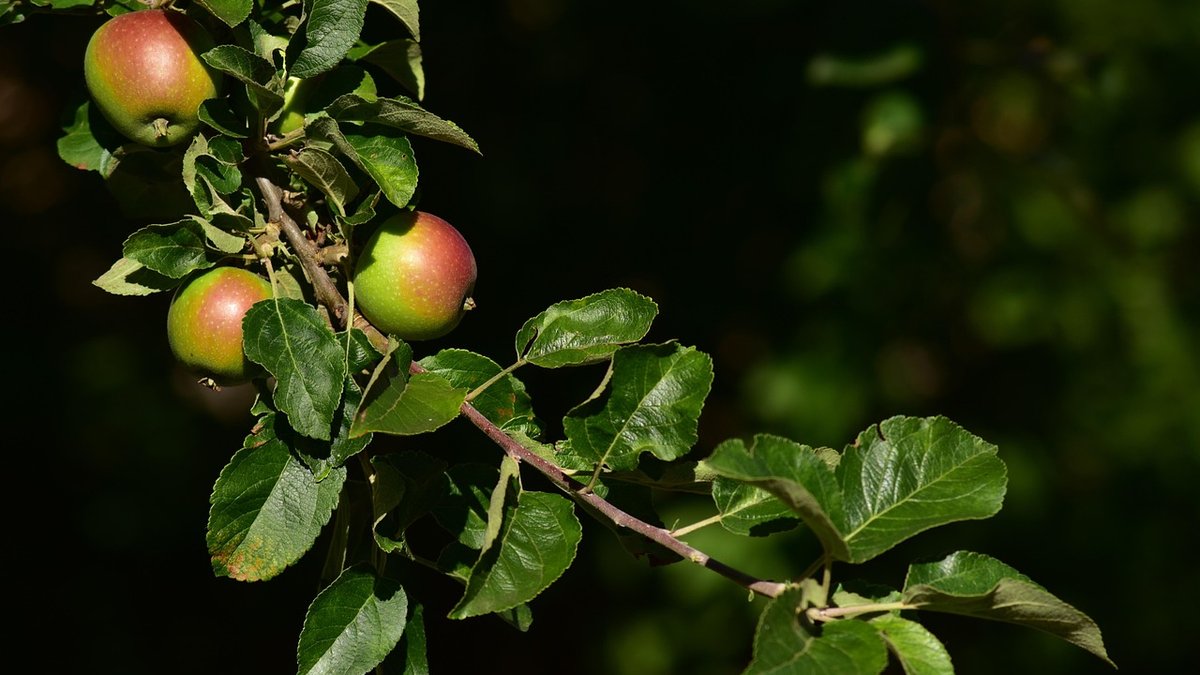
An apple tree left to its own devices will still crop, but it will do so grudgingly. The canopy closes in, branches rub and cross, and the centre of the tree becomes a damp, shaded tangle where scab, canker and woolly aphid thrive. Fruit forms only on the outside, small and crowded, and in a bad year the tree may decide to take a rest altogether.
Winter pruning is simply a conversation with the tree. You are removing what it does not need, opening the canopy to light and moving air, and encouraging it to spend its energy on good fruit rather than on a thicket of weak wood. Do it well and you will see the difference within a season: larger apples, better colour, fewer disease problems, and a tree that carries a heavy crop without splitting a limb.
The dormant season runs from leaf fall to bud burst, but not all of it is equally good. Aim for late November to the end of February, on a dry, mild day when the wood is not frozen. Pruning in a hard frost can shatter tissue and cause dieback, and cuts made in October, while leaves are still hanging on and sap is moving, often produce soft regrowth that winter cold will kill.
There are exceptions worth knowing:
Before you pick up the secateurs, check how your variety fruits. Most apples — Cox's Orange Pippin, Bramley's Seedling, Egremont Russet — are spur bearers. They carry fruit on short, stubby spurs produced on wood that is two years old or more. Pruning these trees encourages new growth, which in turn becomes next year's spur wood.
A few older varieties, including Discovery, Worcester Pearmain and Irish Peach, are tip bearers, fruiting at the ends of the previous season's shoots. Prune a tip bearer as you would a spur bearer and you simply cut off the crop. Give them only a light tidy, thinning out crowded wood and removing the three Ds, and leave the young shoots alone.
Whichever you have, work to a simple target: an open, goblet-shaped framework of well-spaced branches with a clear centre, where light reaches the middle of the tree and you can see sky through it.
Work through the tree in a set sequence and you will not go far wrong:
On young trees, shorten the previous year's growth on the main leaders by about a third, cutting just above an outward-facing bud. Make the cut about 5mm above the bud and slope it slightly away from it. On mature trees, prune far more lightly: remove the congested wood, shorten a few laterals, and stop.
Never leave stubs. Cut back to a bud, a side shoot or the branch collar — the slight swelling where a branch joins its parent. Cuts made flush to the trunk remove the tree's natural defence zone; cuts made halfway along a branch leave dying wood that invites disease.
An overgrown orchard tree that has not been touched in fifteen years is not a one-winter job. Spread the work over two or three seasons, taking out the oldest and most crowded limbs a few at a time, and never remove more than about a quarter to a third of the canopy at once. A very old tree pushed too hard will respond with a forest of weak water shoots and little fruit.
Start with the obvious: dead wood, rubbing branches, and anything growing into the centre. Then, in the following winters, work outward and downward, lowering the crown if the tree has grown too tall to pick. Expect a flush of new growth the summer after heavy cutting — thin these shoots the following winter, keeping the strongest and best placed.
Clear your prunings as you go and burn or bin anything diseased; do not add canker-infected wood to the compost heap. Modern advice is to leave clean cuts unpainted — they seal themselves better than a layer of wound paint allows.
Finish with a mulch of well-rotted manure or compost spread over the root area, kept clear of the trunk itself, and a light feed in early spring if the tree looks tired. Thin the fruit set after the natural June drop if the crop is heavy, leaving one apple every four to six inches. Give a mature tree this treatment each winter and it will reward you for decades — which, after all, is the whole point of growing heritage fruit.

Hi, my name is Anthony kuber. I am artist and fashion designer.
I love to travel and writing blogging.
Your email address will not be published. Required fields are marked *
Software Developer & Writer
Hey, I'm Diva, a developer and writer blending code and creativity. I'm driven by a deep curiosity and a relentless pursuit of excellence. Join me as I craft digital solutions and captivating stories.


