
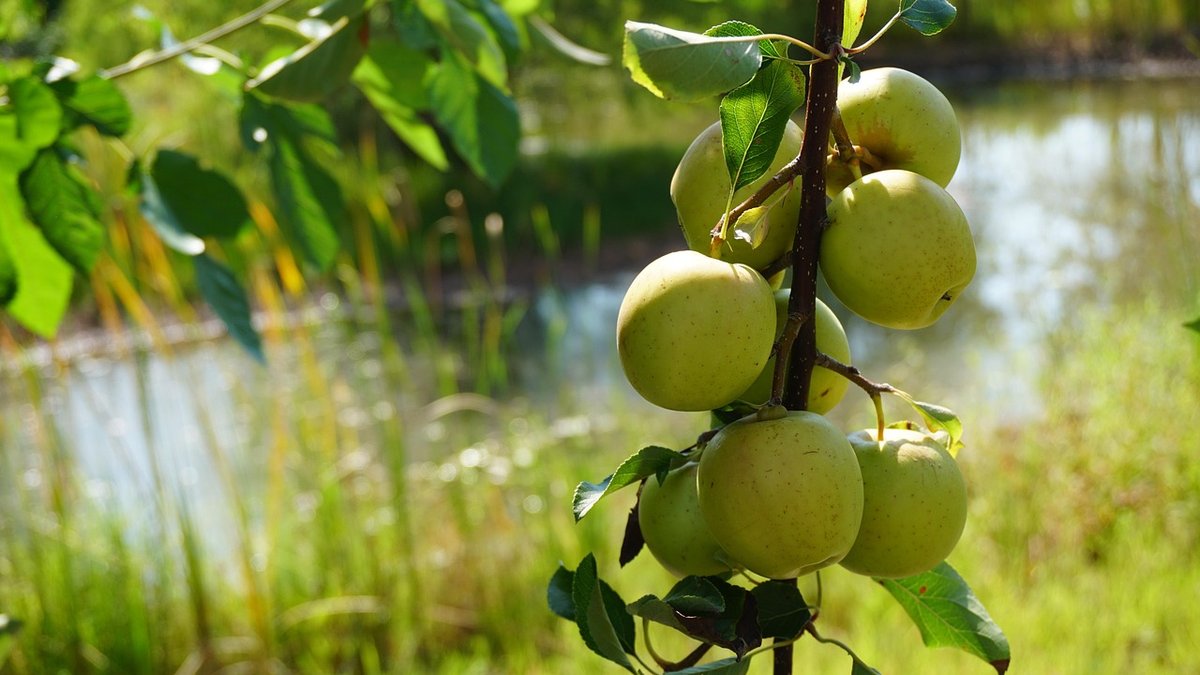
Before you fall in love with a variety, measure the spot you have in mind. A mature apple tree on a vigorous rootstock can easily reach six metres across, which is wonderful in a half-acre orchard and a nuisance in a courtyard. Most British gardeners are working with something far smaller: a strip of lawn, a south-facing wall, or a corner of an allotment plot shared with a shed and a water butt.
The good news is that apples are unusually accommodating. Grafted onto the right rootstock, a tree that would naturally be a forest giant can be kept to two metres and grown in a large pot on a patio. The variety determines the flavour, but the rootstock determines the size, the lifespan and how quickly you will be picking fruit. Get that pairing right and everything else becomes much easier.
Every apple you buy is two plants joined together. The top part, the scion, gives you the fruit. The bottom part, the rootstock, controls how big the tree grows and how soon it crops. In the UK, the choice usually comes down to a handful of well-tested options.
If you are training a tree as an espalier, fan or cordon against a wall or fence, you want a dwarfing rootstock such as M9 or M26, because you will be pruning hard to shape every year. For a free-standing tree in a lawn, M26 or MM106 gives you something robust that will not keel over in a gale.
Most apples are not self-fertile. They need pollen from a different variety that flowers at the same time, carried by bees and other insects. This is where pollination groups come in. Varieties are sorted into groups, usually numbered one to six, based on when they bloom.
The rule of thumb is simple: choose a partner from the same group, or from the group immediately above or below. A group 3 tree will pollinate a group 2, 3 or 4 tree, but probably not a group 5. In a suburban street with mature gardens, you may already have willing partners within bee range, which is often around a hundred metres or so on a still day. On an exposed allotment with few other fruit trees, you should plant two compatible varieties yourself.
There are a few partly self-fertile varieties, including 'Discovery', 'Katy' and the reliable old favourite 'James Grieve'. These will set some fruit alone, but they still crop far better with a partner. If space is genuinely tight, a family tree — two or three varieties grafted onto one trunk — solves the problem neatly, though you will need to prune to keep the weaker branches in check.
Britain is a patchwork of microclimates, and apples notice. In the damp, mild west, scab and canker are the main enemies, so look for resistant varieties such as 'Ashmead's Kernel', 'Bramley's Seedling' or 'Egremont Russet'. In the drier east and south-east, you have more freedom, and later-ripening varieties will finish well in the extra warmth.
Further north, choose early and mid-season apples that ripen before the cold and wet close in. 'Discovery', 'Beauty of Bath' and 'Keswick Codlin' are old northern stalwarts for good reason. Frost pockets are another consideration: a low corner where cold air collects can nip blossom in May and cost you the crop. Plant on a slight slope or against a wall if you can.
Soil matters too. Apples dislike waterlogged ground far more than they dislike poor ground. If your plot holds water in winter, plant on a slight mound or improve drainage with grit and organic matter before you dig the hole.
Britain has an extraordinary apple heritage, and many of the best-tasting varieties are the older ones. They are not always the prettiest, but they carry flavours you will never find in a supermarket punnet.
Buy bare-root trees between November and March if you can. They establish better, cost less and give you a far wider choice than the potted trees on offer in spring.
Dig a hole wide rather than deep, roughly twice the spread of the roots, and fork the base to break up any pan. Set the tree so that the graft union — the knobbly join — sits about ten centimetres above soil level. Firm it in well, water thoroughly, and stake dwarfing trees for life.
Keep a clear metre of bare soil or mulch around the trunk for the first few years, and water deeply in dry spells during the first two summers. Feed in late winter with a balanced general fertiliser, and mulch with well-rotted manure in spring, keeping it clear of the trunk. Then be patient: on a dwarfing rootstock you may pick your first proper crop in three or four years, and the best is yet to come.

Hi, my name is Anthony kuber. I am artist and fashion designer.
I love to travel and writing blogging.
Your email address will not be published. Required fields are marked *
Software Developer & Writer
Hey, I'm Diva, a developer and writer blending code and creativity. I'm driven by a deep curiosity and a relentless pursuit of excellence. Join me as I craft digital solutions and captivating stories.


